
Carbon fiber and fiberglass are the two dominant face materials in modern pickleball paddle construction, and the choice between them shapes a paddle's feel more than almost any other spec. Both are legal, widely used, and available across every price tier — the difference is in the playing characteristics each material tends to produce, not in one being objectively superior. This article breaks down how the two compare and how manufacturers typically decide between them.
What carbon fiber brings to a paddle face
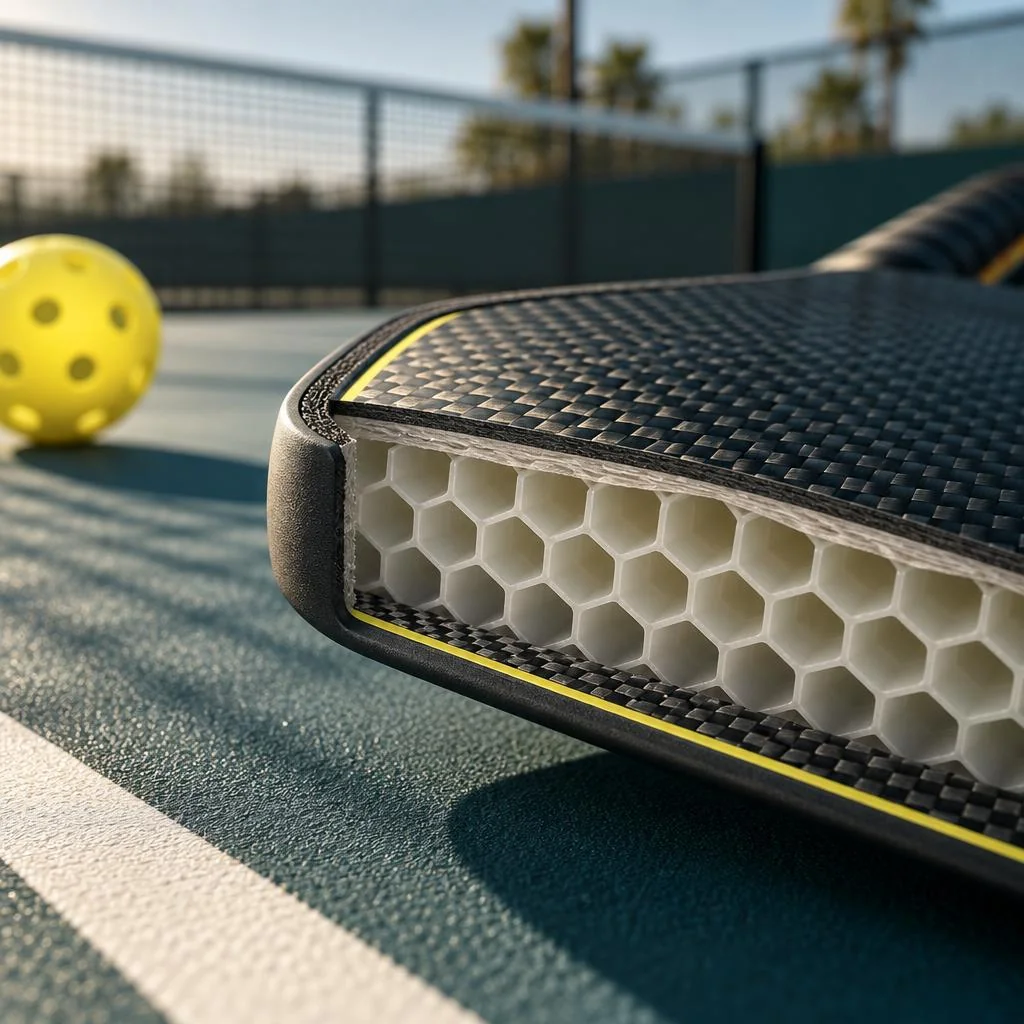
Carbon fiber, often applied as a woven or unidirectional prepreg layer over the core, is prized for its high stiffness-to-weight ratio. This stiffness generally translates to a firmer response on contact — the ball comes off the face quickly with less energy absorption from the material itself, which experienced players often describe as more "direct" or precise feedback. That same stiffness generally means less inherent power boost from the face material alone, putting more of the power equation on the player's own swing and on core thickness. Carbon fiber faces are also generally associated with a firmer, sometimes louder sound on contact compared to fiberglass.
Within carbon fiber itself, there's also variation in weave pattern and layup orientation — woven carbon generally produces a slightly more textured surface than unidirectional prepreg, which can subtly affect both feel and, within tested limits, spin characteristics. Manufacturers select between these based on the specific playing profile they're targeting for a given model, rather than treating "carbon fiber" as a single uniform material.
What fiberglass brings to a paddle face
Fiberglass faces are generally more flexible than carbon fiber, which lets the surface absorb and return more energy on contact — often described as extra "pop" or inherent power. This same flexibility generally produces a larger forgiving sweet spot, since the face can compensate somewhat for slightly off-center contact. The trade-off is generally less precision on soft shots, since the added flex can make touch shots like dinks and resets harder to control with the same consistency as a stiffer carbon face.
Fiberglass is also generally more visually customizable, since it can be finished in a wider range of colors and translucent effects than carbon fiber's more limited woven-black or textured-gray appearance. This is a secondary consideration compared to feel, but it's part of why fiberglass remains popular for playfully branded or retail-focused product lines.
Feel, sound and durability differences
Beyond the power-versus-control trade-off, the two materials tend to differ in a few secondary ways. Carbon fiber generally produces a crisper, sometimes higher-pitched sound on contact; fiberglass generally produces a duller, softer sound. On durability, both materials can hold up well when manufactured with proper resin distribution and edge sealing — reported wear differences between the two often have more to do with build quality and usage intensity than with the base material itself. Composite and hybrid layups that blend carbon and fiberglass layers exist specifically to split the difference between these characteristics.
How the choice interacts with core thickness
Face material rarely works in isolation — it's typically paired deliberately with core thickness to hit a specific playing profile. A carbon face paired with a thinner core produces a very control-and-precision-oriented paddle with a crisp, low-power response. A fiberglass face paired with a thicker core (commonly toward the 14.1–16mm range) produces a much more forgiving, touch-friendly paddle. Manufacturers building out a product line generally vary both variables together rather than changing just one, since the interaction between them defines the final feel more than either spec alone.
How manufacturers and brands decide between them
From a production standpoint, both materials are well established in the manufacturing cluster that supplies most of the market, and neither is inherently more expensive to source at meaningful volume — cost differences usually come down to grade of material and finishing process rather than carbon versus fiberglass as a category. Brands typically choose based on the playing profile they want the paddle to have, then validate that choice through sample testing before committing to a production run. Our sourcing and factory page covers the full material system — face options, core types and construction processes — available when specifying a paddle for a private-label or retail line.
Which one should you choose as a player
If you already know you favor control and touch, a carbon fiber face is generally the more natural starting point. If you're still developing consistent contact, or you play a power-oriented game and want the material itself to help generate pace, fiberglass is generally the more forgiving option. Players who can't decide often do well with a composite or hybrid face that blends both characteristics — and in all cases, testing the material in person, where possible, will tell you more than any spec comparison.
Hybrid Constructions: Getting Both
The binary framing of carbon versus fiberglass hides a practical middle path. Many manufacturers offer hybrid faces that combine a carbon fiber hitting zone with fiberglass outer sections, seeking a compromise between carbon's controlled feel and fiberglass's livelier response. Hybrids tend to sit between the two pure constructions on nearly every characteristic: power, touch, durability and cost.
For buyers and brands, hybrids are worth evaluating on their own terms rather than as a diluted version of either material. A well-executed hybrid can cover a wide range of playing styles, which also makes it an attractive candidate for private-label lines that need one or two SKUs to serve varied customers. The same evaluation logic applies: check the layup specification, ask how the two materials are bonded, and confirm that quality control screens for delamination between layers.